 सकल गोर बंजारा
एकच सांस्कृतिक ओळख — विविध राज्यांतील तुलनात्मक पुरावे
Same cultural identity, documented through God and Sant traditions, Tanda life, Gor Boli, dress, history, social structure and state-wise reservation classification.
ही माहिती शैक्षणिक व जनजागृतीसाठी आहे. कायदेशीर पात्रता नेहमी अद्ययावत सरकारी अधिसूचनेनुसार ठरते.
बंजारा समाजातील श्रद्धा, देवता आणि संत परंपरा
Banjara religious life is diverse and region-sensitive. Family deities, village deities, nature-linked worship, regional Hindu traditions and Sant traditions coexist. Practices should not be presented as identical in every Tanda or state.
Sant Sevalal Maharaj
Widely revered in many Banjara communities as a spiritual guide and symbol of truth, dignity, service, moral conduct and community unity. Poharadevi in Maharashtra is an important centre of devotion associated with Sant Sevalal Maharaj.
Regional narratives, dates and ritual forms should be documented from verified temple or government sources.
Jagdamba / Mariamma Traditions
Forms of the Mother Goddess are worshipped under different regional names. Devotion may include community vows, seasonal observances, offerings, songs and collective prayer.
Names and customs vary across Maharashtra, Karnataka, Telangana, Andhra Pradesh and other regions.
Nature, Ancestors & Local Deities
Traditional belief systems may include respect for ancestors, sacred places, protective deities, hills, trees, water sources and Tanda-level ritual traditions.
These are living oral traditions; local verification is essential before naming a custom as universal.
Regional Hindu Traditions
Many Banjara families also participate in regional worship of deities such as Shiva, Hanuman, Krishna, Vithoba, Khandoba, Balaji and local Gram Devata traditions according to the state and local history.
Bhajans, Jagrans & Oral Devotion
Devotional songs, community recitations, stories of saints, ritual singing and remembrance through Gor Boli are important channels of intergenerational transmission.
Important Documentation Rule
Temple history, saint biographies and miracle claims must be separated into: verified historical record, community oral tradition and devotional belief.
तांडा संस्कृती : वस्ती, सामूहिक जीवन आणि परंपरा
What is a Tanda?
A Tanda is traditionally a Banjara settlement and social space formed around kinship, mobility, mutual support, leadership, common memory and shared cultural practices. Historically, the term was also associated with travelling groups and caravan organisation. In settled life, the Tanda developed as a distinct habitation unit.
Settlement pattern
Clusters of households, internal pathways, common meeting spaces, places of worship and links with fields, grazing or nearby villages.
Collective responsibility
Families traditionally cooperate during ceremonies, disputes, emergencies, agricultural work and festivals.
Community leadership
Traditional leadership roles and councils historically supported order and mediation. Modern constitutional law, Gram Panchayat institutions and formal administration remain legally supreme.
Hospitality and identity
Guest reception, food sharing, respect for elders, kinship and participation in community ceremonies are strong social values.
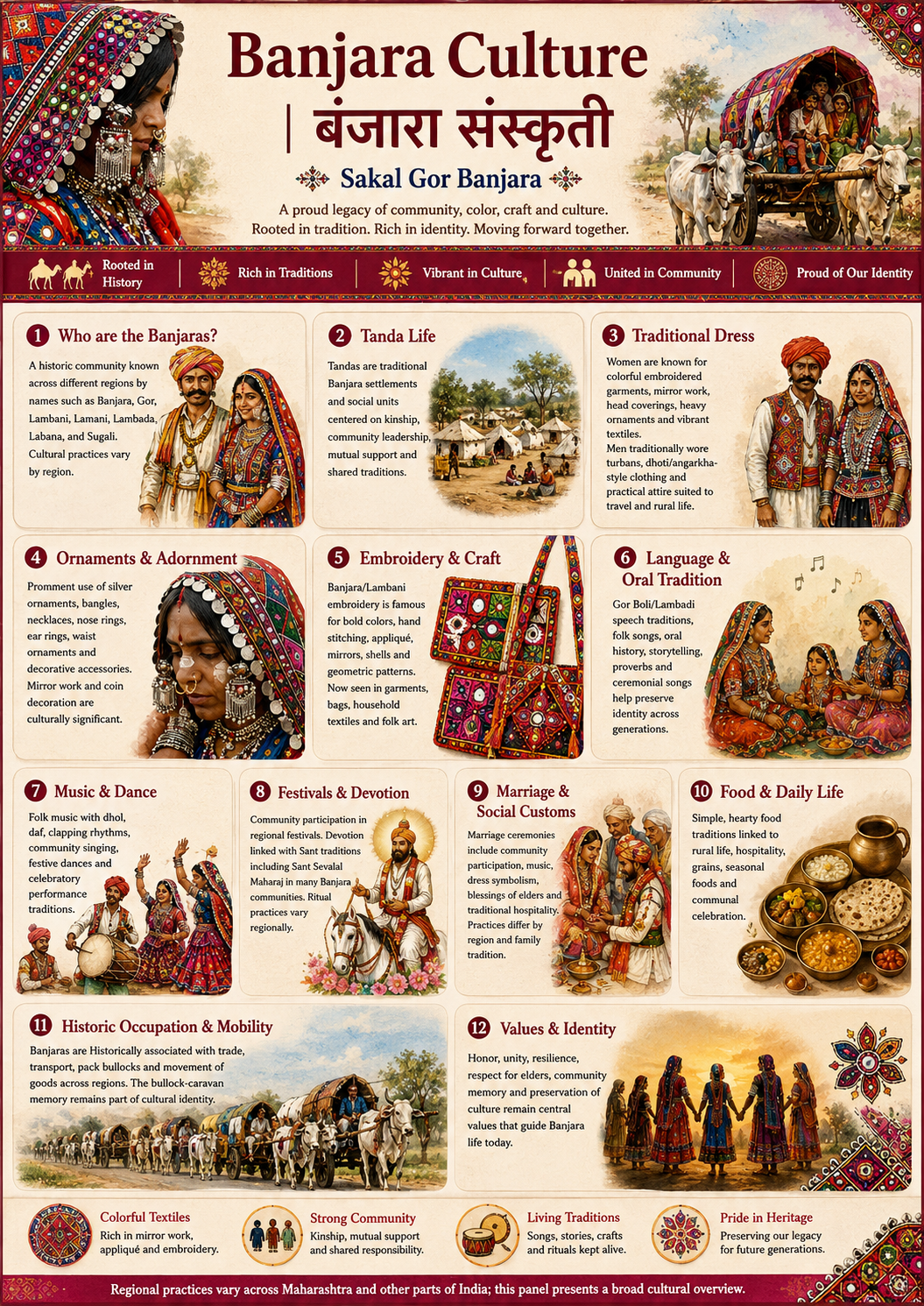
Living Tanda Culture
Language, dress, embroidery, songs, marriage customs, festivals and community memories are maintained through everyday Tanda life.
Birth & Childhood
Naming, blessings, family support and oral transmission of language and values.
Marriage
Collective participation, music, traditional attire, elders’ blessings and hospitality.
Festivals
Regional festivals, Sant Sevalal observances, seasonal gatherings and community worship.
Music & Dance
Dhol, daf, clapping rhythms, group songs, festive dancing and ceremonial performance.
Food
Grain-based rural food, seasonal ingredients, shared meals and generous hospitality.
Craft
Embroidery, mirror work, textile decoration and ornament traditions, especially associated with women’s skill.
Changing Tandas
Education, migration, urban employment and digital communication are reshaping, but not erasing, Tanda identity.
Preservation
Community archives, recorded oral histories, Gor Boli education and craft support are essential for continuity.
Gor Boli, Lambadi, Lamani and regional multilingualism
The community’s speech is known by names including Gor Boli, Gormati, Lambadi, Lamani, Lambani and Banjari. Naming, vocabulary, pronunciation and script use vary by region.
| State / Region | Common community-language names | Strong contact languages | Writing practice |
|---|---|---|---|
| Maharashtra | Gor Boli, Banjari, Lamani | Marathi, Hindi | Devanagari is commonly used for community writing and publications. |
| Karnataka | Lambani, Lamani | Kannada, Marathi, Telugu | Kannada and Devanagari may be used depending on locality and publisher. |
| Telangana | Lambadi, Banjara | Telugu, Urdu, Hindi | Telugu or Devanagari-based writing may be seen; oral use remains central. |
| Andhra Pradesh | Sugali, Lambadi | Telugu | Telugu script is frequently used in local materials. |
| Madhya Pradesh / Chhattisgarh | Banjari, Banjara, Lamani variants | Hindi and regional languages | Devanagari is commonly used. |
| Rajasthan / Gujarat | Banjari, Labani/Labana-related local names, regional variants | Rajasthani varieties, Hindi, Gujarati | Devanagari or Gujarati according to region. |
| Odisha | Banjara / regional community speech | Odia, Hindi | Odia and Devanagari according to context. |
Oral Heritage
Folk songs, lullabies, marriage songs, devotional songs, proverbs, riddles, genealogical memories and stories preserve social history.
No Single Universal Script
Gor Boli is primarily an oral language tradition. Writers use scripts of their state, especially Devanagari, Kannada and Telugu. A script used in one region should not be falsely presented as universally accepted.
Preservation Priorities
Community dictionaries, children’s readers, audio archives, folk-song documentation, teacher resources and Census-based language research are needed.
रंग, आरसे, भरतकाम आणि चांदीच्या अलंकारांची परंपरा
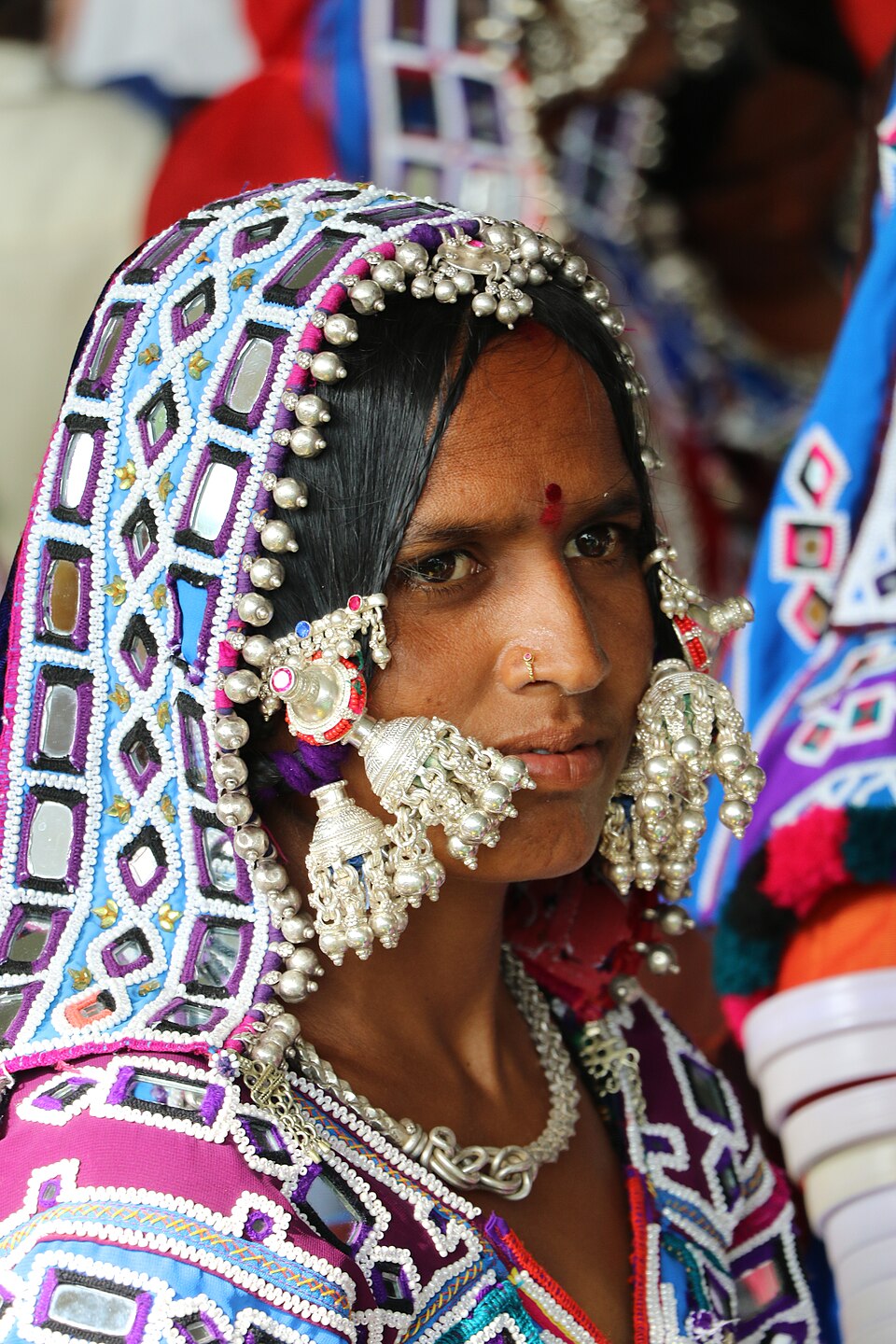
Banjara/Lambani dress is one of the community’s most visible cultural markers. However, garment names, construction, ornament use and ceremonial dress differ by age, marital status, locality and state.
Women’s Garments
Traditionally include a full skirt or phetiya/ghaghra, blouse or kanchali, and an embroidered head covering or veil. Names and forms differ regionally.
Embroidery
Dense hand stitching, mirrors, appliqué, patchwork, shells, cowries, tassels and bold geometric arrangements are characteristic of many Lambani/Banjara textiles.
Ornaments
Traditional adornment may include necklaces, earrings, nose ornaments, bangles, armlets, anklets, waist ornaments, hair accessories and coin-like decorative elements.
Men’s Dress
Historically included turban styles, dhoti, kurta or angarkha-type upper garments, waist cloths, jackets and practical clothing suited to travel, cattle work and rural life.
Craft recognition and continuity
Sandur Lambani Embroidery is registered as a Geographical Indication for Karnataka. This demonstrates formal recognition of a regional Lambani textile tradition, but the GI’s geographical scope should not be presented as covering every Banjara craft tradition in India.
Modern artisans adapt traditional work into bags, garments, wall pieces, accessories and home textiles. Fair payment, artisan attribution and prevention of design exploitation are important.
उत्पत्ती, व्यापारी तांडे, वसाहतवादी कायदे आणि आधुनिक परिवर्तन
Origin: multiple historical views
Scholars and community traditions connect Banjara history with north-western and western India, including Rajasthan and adjoining regions. Exact ancestry is debated and should not be stated as finally settled.
Trade and pack-bullock transport
Banjaras were historically associated with moving grain, salt and other goods through organised caravans of pack bullocks across long distances.
Tanda mobility
The travelling Tanda functioned as an economic and social unit, with leadership, transport knowledge, animal management and route networks.
Service to armies and markets
Caravan transport was important to pre-modern markets and military supply systems. The community’s role differed by region and political period.
Railways and economic disruption
Expansion of railways, roads and new market systems reduced the older caravan economy, pushing many groups toward agriculture, labour and settled occupations.
Colonial Criminal Tribes framework
Colonial laws stigmatized numerous mobile and denotified communities. The framework was repealed after independence, but social prejudice and disadvantage continued.
Denotification after independence
Communities formerly notified under colonial law came to be described as Denotified Tribes/Communities; legal and welfare classifications later developed differently across states.
Modern identity
Today Banjara/Lamani/Lambadi/Sugali communities participate in education, public service, agriculture, business, arts, politics and urban employment while preserving cultural identity.
एकाच/समान समुदायनावांचे राज्यनिहाय वेगवेगळे कायदेशीर वर्गीकरण
Reservation status is determined by the exact notified community entry, state/UT, applicable Presidential Order or backward-class list, and certificate-validation rules—not by cultural similarity alone.
| State / context | Common relevant names | Broad classification shown in official lists | Important caution |
|---|---|---|---|
| Maharashtra | Banjara and notified synonymous entries as applicable | Vimukta Jati-A / VJNT state framework | Not presently a Scheduled Tribe entry for Maharashtra merely because related names are ST elsewhere. |
| Telangana | Sugali, Lambadi, Banjara | Scheduled Tribe | Eligibility is tied to the Telangana ST list and certificate rules. |
| Andhra Pradesh | Sugali, Lambadi, Banjara | Scheduled Tribe | State-specific Presidential Order entry applies. |
| Odisha | Banjara / Banjari | Scheduled Tribe entry in the notified list | Exact spelling and territorial/legal conditions must be checked from the current order. |
| Karnataka | Lambani, Banjara and related notified names | State classification must be read from current SC/ST/OBC notifications; community names have had distinct legal treatment | Do not infer status from cultural identity or GI craft recognition. |
| Other states / Union Territories | Labana, Banjara, Lamani, Lambani and local variants | May appear as SC, ST, OBC or another state category, or may not appear | Every state list requires separate verification. |
Why classifications differ
SC and ST lists are notified state/UT-wise under Articles 341 and 342. Backward-class and denotified/nomadic frameworks also differ between state and central systems.
Migration rule
A person generally cannot claim another state’s SC/ST benefit in the destination state solely because the same or similar community name is recognised there. Origin-state rules and current law must be checked.
ST inclusion process
State proposal → Registrar General of India examination → National Commission for Scheduled Tribes opinion → Union Cabinet → Parliament amendment → Presidential assent.
Published Comparative Evidence
Database records approved through the portal appear below.
Core official and research sources
Banjara ethnographic material on origin traditions, dress, occupations and cultural practices.
Open official repository documentOfficial framework for state-wise mother-tongue and language distribution research.
Open Census Language AtlasOfficial registration details for Sandur Lambani Embroidery, Karnataka.
Open GI registrationPrimary reference for comparing current notified Scheduled Tribe entries across states.
Open state-wise ST listVerification status: Educational comparative overview. Legal and historical records should be periodically rechecked against the latest official orders, reports and authenticated publications.
कुटुंब, कुळ, तांडा, नेतृत्व आणि बदलती सामाजिक व्यवस्था
Core social units
Traditional and constitutional institutions
Traditional councils and leadership may have cultural value, but they cannot override the Constitution, criminal law, civil law, women’s rights, child-protection law, elected Gram Panchayat institutions or courts.
Social values frequently emphasized
Unity, honour, hospitality, respect for elders, mutual assistance, celebration through collective participation, memory of ancestors and protection of community identity.
Marriage relations
Kinship and clan rules historically shape permissible marriage relations. Actual practice differs by subgroup and region and must be documented locally.
Economic change
Agriculture, wage work, transport, government service, entrepreneurship, education and urban migration have diversified livelihoods.
Current priorities
Education, women’s safety and opportunity, youth employment, documentation, health, land and housing access, language preservation and constitutional awareness.